Redevelopment can help property owners replace ageing buildings, improve living conditions and unlock the development potential of valuable land. However, the process also involves significant legal and financial commitments. A poorly drafted agreement, unclear developer obligations or inadequate safeguards can expose a housing society and its members to prolonged disputes, delayed possession and financial loss. Understanding redevelopment agreement legal issues before signing is therefore essential.
A redevelopment agreement is more than a commercial arrangement with a developer. It governs the use of the property, the rights of existing owners, construction obligations, temporary accommodation, compensation and the delivery of replacement premises. Property owners should assess the agreement carefully, verify the developer’s capacity and ensure the contract provides clear remedies if the project does not proceed as promised.
What Is a Redevelopment Agreement?
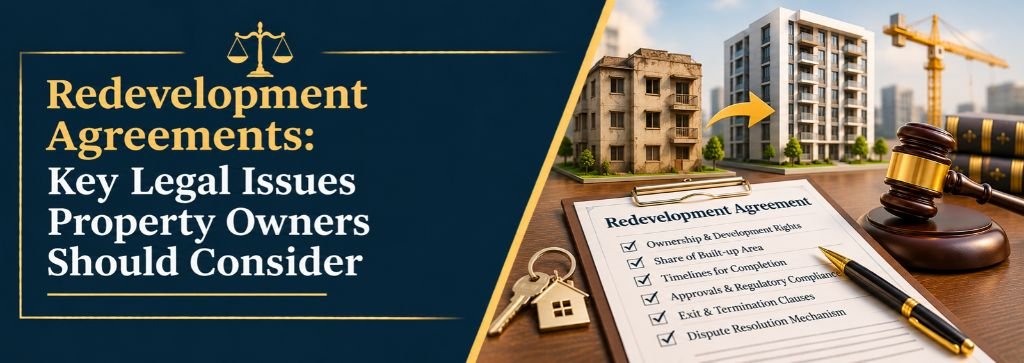
A redevelopment agreement is a contract under which a property owner, landowner or housing society grants a developer specified rights to redevelop an existing property. In return, the developer generally agrees to construct replacement premises for existing occupants or members and may receive additional development potential or the right to sell newly created units.
In a cooperative housing society redevelopment, the agreement usually records the society’s consent, the developer’s responsibilities, the area and specifications of replacement flats, transit accommodation, rent or hardship compensation, construction timelines and handover conditions. The exact structure varies according to the title of the land, the society’s legal status, local development regulations and the project model.
The agreement may also be accompanied by a power of attorney, individual permanent alternate accommodation agreements, supplementary agreements and other approvals. These documents should be consistent. An inconsistency between the development agreement and individual member documents can create uncertainty about enforceable rights.
Key Legal Issues in a Redevelopment Agreement
1. Verification of Property Title and Development Rights
Before appointing a developer, property owners should establish who owns the land and building and whether the society has the legal authority to undertake redevelopment. Relevant records may include the conveyance deed, property card, title documents, lease deed, land records, society registration documents and existing approvals.
The position can be more complicated where land is held on lease, belongs to a public authority or is subject to restrictions imposed by MHADA or another statutory body. The society should confirm whether the lease conditions permit redevelopment and whether consent or a no objection certificate from the landowner or authority is required.
A title dispute or an undisclosed encumbrance can delay approvals and affect the developer’s ability to complete the project. Independent title due diligence should therefore take place before the society grants development rights.
2. Consent of Society Members and Decision Making
Redevelopment decisions must follow the applicable cooperative law, registered bye laws and state government directions. In Maharashtra, the Government Resolution dated 4 July 2019 sets out a procedure for redevelopment of cooperative housing society buildings, including member participation, meetings, appointment of professionals and developer selection.
The society should maintain proper records of notices, meeting minutes, voting, resolutions and written consents. Members should receive relevant information about the proposed project, including the developer’s offer, additional area, compensation and construction schedule. A decision reached through an improper process may lead to challenges by dissenting members and delay the project.
The applicable consent threshold should not be assumed to be identical for every redevelopment. Different statutory schemes, types of property and local development regulations may prescribe different requirements. The society should verify the rule applicable to its project rather than rely on a general percentage circulated informally. Maharashtra Government resolutions and redevelopment notifications.
3. Selection of the Developer and Financial Due Diligence
The developer’s financial capacity and track record are central to the success of redevelopment. A society should examine completed projects, pending litigation, insolvency proceedings, financial statements, existing project commitments and the developer’s ability to obtain construction finance.
The highest additional area or rent offer may not necessarily represent the safest proposal. A developer with inadequate funds or a history of delayed projects may struggle to pay transit rent, obtain approvals or complete construction. The society should also consider whether the proposed project is commercially viable and whether the developer has realistic access to the required permissions and development potential.
The selection process should be transparent and supported by comparative evaluation. An independent architect, project management consultant and legal adviser can help assess technical feasibility, financial terms and contractual risks.
4. Additional Area, Flat Specifications and Entitlements
The agreement should clearly state the carpet area promised to each existing member and the method used to calculate it. It should also identify the floor, flat number where feasible, layout, balcony or terrace rights, parking entitlement, fixtures, fittings and other facilities. Vague expressions such as “equivalent flat” or “additional area as mutually agreed” can create disputes during allotment.
The agreement should distinguish between the area available to existing members and the sale component retained by the developer. It should also explain how changes in sanctioned plans, floor space index (FSI), transferable development rights (TDR) or other development potential will affect the parties. Any promise of additional area should be measurable and enforceable, rather than dependent on an undefined future approval.
5. Transit Rent, Shifting Costs and Temporary Accommodation
Members may need to vacate their existing homes before construction begins. The developer’s obligations during this period should be detailed in the agreement. These usually include monthly transit rent, security deposit where agreed, shifting charges, brokerage or temporary accommodation assistance and compensation for any additional period of delay.
The agreement should specify when rent payments begin, how frequently they must be paid, whether rent increases after a defined period and what happens if payment is missed. It should also state whether the developer must provide temporary accommodation or whether members can arrange their own housing.
A clause promising rent without a clear payment date or enforcement mechanism offers limited practical protection. Property owners should consider seeking advance rent, an escrow arrangement, bank guarantee or other suitable security, depending on the project’s financial structure.
6. Construction Timeline and Delay Consequences
The redevelopment agreement should establish clear milestones for obtaining approvals, issuing vacation notices, securing possession of the site, commencing construction and handing over completed premises. The start date for calculating the construction period must be precisely defined. For example, the agreement should clarify whether the period begins from execution, receipt of the commencement certificate or another agreed event.
It should also define the consequences of delay. These may include enhanced transit rent, interest, liquidated damages or termination rights, subject to applicable law. Force majeure provisions should be carefully drafted. They should cover genuine events beyond the developer’s control and should not become a broad excuse for ordinary financial, management or contractor related delays.
7. Approvals, Sanctioned Plans and Regulatory Compliance
The developer should be responsible for obtaining the approvals required for lawful construction. Depending on the location and project, these may include building plan sanctions, commencement certificates, environmental permissions, fire safety approvals, airport authority clearances and permissions from the landowning authority.
The agreement should identify which party is responsible for each approval, who bears the costs and how delays caused by regulatory authorities will be handled. Owners should not rely solely on verbal assurances about permissible FSI or the feasibility of the proposed building.
The final construction must comply with sanctioned plans and applicable building regulations. Material deviations can affect the legality, safety and value of the completed property.
8. RERA Applicability and Protection of Existing Members
RERA may apply to a redevelopment project where the statutory requirements for registration are met, particularly where the developer is constructing units for sale to outside purchasers. However, its application to a society redevelopment is fact specific. The nature of the project, the number of units, the land area, the sale component and applicable exemptions must be examined.
Existing members should not assume every aspect of their rehabilitation arrangement is automatically protected in the same way as a sale to a new allottee. Their rights will also arise from the development agreement, individual accommodation documents, cooperative law and other applicable legal provisions.
The agreement should clearly allocate responsibility for RERA registration, disclosures, compliance, project updates and obligations towards purchasers of sale component units. The society should also understand how any RERA proceedings or regulatory directions may affect the redevelopment schedule.
9. Security, Insurance and Protection Against Developer Default
A redevelopment agreement should provide meaningful safeguards if the developer fails to perform. Depending on the project, these may include a bank guarantee, performance security, escrow arrangements, insurance and restrictions on creating third party rights before specified milestones.
The contract should also address the consequences of the developer’s insolvency, loss of funding, abandonment of construction or failure to pay transit rent. Owners should consider whether the developer can mortgage or otherwise encumber development rights, and whether society approval is required for particular transactions.
Insurance should cover relevant construction risks and third party liability. The agreement should identify the party responsible for maintaining coverage and providing policy documents. A society should not rely only on the developer’s promise to arrange insurance at a later stage.
10. Termination, Dispute Resolution and Change of Developer
Termination provisions should identify what constitutes a material breach, the notice required, the time allowed to remedy a default and the consequences of termination. The agreement should also address possession of the site, unfinished construction, outstanding rent, documents, approvals and the transfer or handover of project records.
Disputes may be resolved through arbitration, civil proceedings, cooperative authorities or statutory forums, depending on the nature of the dispute and the parties involved. An arbitration clause should specify the seat, appointment procedure and scope of disputes covered. It should not be assumed that every statutory or regulatory dispute can be referred to private arbitration.
Changing a developer is particularly sensitive where the development agreement is registered or the developer has created enforceable rights. A society should follow the contractual termination procedure and obtain legal advice before appointing a replacement developer.
A significant illustration is the Supreme Court’s decision in A A Estates Private Limited v. Kher Nagar Sukhsadan Co-operative Housing Society Ltd. (2025 INSC 1366). The Court upheld termination in the particular circumstances, where prolonged non performance, failure to commence redevelopment and repeated defaults were established. It also considered the effect of the developer’s insolvency proceedings. The judgment highlights the importance of clear default clauses, proper notices and documented termination steps. It does not mean a society can terminate every redevelopment agreement unilaterally or without following the contract and applicable law. Read the Supreme Court judgment in A A Estates v. Kher Nagar Sukhsadan.
Important Clauses to Include Before Signing a Redevelopment Agreement
A carefully drafted agreement should address the full lifecycle of the project, from the developer’s appointment to the final handover. It should clearly record the existing members’ entitlements, construction specifications, payment obligations, approval responsibilities and the process for resolving disputes.
Property owners should pay particular attention to the following contractual protections:
- Performance security: A bank guarantee or other suitable security against non performance.
- Rent and compensation: Defined payment dates, escalation and consequences of missed payments.
- Completion obligations: Clear construction milestones and a final possession deadline.
- Quality standards: Specifications for materials, fittings, common areas and facilities.
- Defect liability: Responsibility for correcting construction defects after possession.
- Insurance: Adequate coverage during demolition and construction.
- Restrictions on transfer: Controls over assignment of development rights or appointment of another developer.
- Termination rights: Clear procedures for default, notice, cure periods and handover following termination.
The agreement should also address stamp duty, registration costs, taxes and responsibility for statutory charges. Development agreements and permanent alternate accommodation documents may attract different legal and financial requirements depending on their structure and the state in which the property is located.
What Should Property Owners Do Before Signing?
Property owners should obtain an independent legal review of the title documents, society resolutions, developer proposal and draft agreement. A technical consultant should assess the proposed building plans, construction specifications, development potential and feasibility. Financial due diligence should establish whether the developer can meet the promised rent, compensation and construction commitments.
The society should also confirm whether the agreement, power of attorney and individual member documents require registration and stamping. Registration can be important for enforceability and public notice of the rights created. The legal effect of each document depends on its terms and applicable property law.
Understanding the Legal aspects of property redevelopment before execution helps owners identify risks while there is still an opportunity to negotiate stronger protections. Once the developer receives possession or acts on the development rights, resolving contractual disputes can become more complicated.
Conclusion
Redevelopment can provide substantial benefits to property owners, but it also involves complex contractual, regulatory and financial considerations. A redevelopment agreement should protect the interests of existing members while clearly defining the developer’s obligations, construction timelines, compensation arrangements and remedies for default.
Property owners should not rely solely on attractive financial offers or verbal assurances. They should verify title, review approvals, assess the developer’s financial capacity and negotiate enforceable safeguards before signing. Seeking Property redevelopment legal advisory at the drafting and negotiation stage can help prevent avoidable disputes and protect the long term interests of the society and its members.
Frequently Asked Questions
1. Is a redevelopment agreement legally binding?
Yes. A validly executed redevelopment agreement creates contractual obligations between the parties. Its enforceability depends on its terms, proper authorisation, applicable legal formalities and compliance with relevant laws.
2. Is every society member required to consent to redevelopment?
Not necessarily. The required consent depends on the applicable state law, government directions, society bye laws and the type of redevelopment. Owners should verify the specific legal requirements before relying on a particular voting threshold.
3. Can a housing society terminate a redevelopment agreement?
A society may be entitled to terminate an agreement where the developer commits a material breach or fails to fulfil contractual obligations. The society must follow the termination clause, applicable legal procedure and any relevant statutory restrictions.
4. What happens if a developer delays redevelopment?
The consequences depend on the agreement and the reasons for delay. Members may be entitled to continued transit rent, contractual compensation, damages or termination in appropriate circumstances. Documented notices and payment records are important when pursuing relief.
5. Is RERA applicable to society redevelopment projects?
RERA may apply where the project meets the statutory registration requirements and no exemption applies. The position depends on factors such as the sale component, project size and nature of the redevelopment. The applicable state rules should be checked.