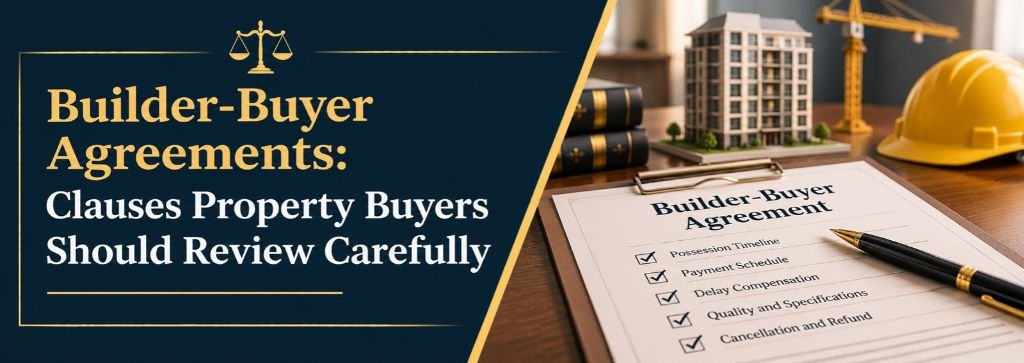
Purchasing a residential or commercial property is a major financial decision. Before making payments or accepting possession commitments, buyers must understand the legal document governing their relationship with the developer. Builder-buyer agreement clauses play an important role in determining ownership obligations, payment schedules, construction timelines, possession rights and remedies in case of contractual breaches.
In India, builder-buyer agreements are governed by applicable contract and property laws, along with the Real Estate (Regulation and Development) Act, 2016 (RERA), and relevant state regulations. Although developers often prepare standard agreements, buyers should not assume every clause is fair or legally enforceable. Certain provisions may create financial liabilities, restrict cancellation rights or limit remedies when construction is delayed. Reviewing the agreement carefully before signing can help buyers protect their interests and avoid future disputes.
What Is a Builder-Buyer Agreement?
A builder-buyer agreement is a legal contract between a property developer and a purchaser. It records the terms governing the purchase of a residential or commercial unit in a real estate project. The agreement generally covers the property’s description, total consideration, payment schedule, construction obligations, possession timeline and responsibilities of both parties.
The agreement becomes an important reference when disputes arise between the developer and the purchaser. Under RERA, the promoter is required to enter into a written agreement for sale with the allottee in the prescribed form before accepting more than ten per cent of the cost of the apartment, plot or building as an advance or application fee. Buyers should therefore examine the agreement before making substantial payments and verify whether its provisions are consistent with the project’s RERA registration and applicable state rules.
Why Should Buyers Review Builder-Buyer Agreement Clauses Before Signing?
Developers frequently use standardised agreement formats, but the legal and financial consequences can vary depending on the wording of individual clauses. An agreement may contain provisions concerning additional charges, construction extensions, cancellation penalties and limitations on the buyer’s remedies. If these terms are unclear or heavily favour the developer, buyers may face difficulties when seeking possession, refunds or compensation.
A careful review helps identify unreasonable obligations and inconsistencies before the transaction becomes binding. Buyers can also seek clarification or negotiate suitable amendments where legally permissible. Understanding the agreement at the beginning is generally easier than challenging an unfavourable provision after making substantial payments.
Important Builder-Buyer Agreement Clauses Every Property Buyer Should Check
1. Property Description and Specifications Clause
The agreement should accurately describe the property being purchased, including the apartment or unit number, floor, carpet area, project name and relevant identification details. It should also specify the layout, fittings, fixtures, parking arrangements and amenities included in the agreed price.
Buyers should compare these details with the allotment letter, approved building plans, project disclosures and RERA registration information. Any mismatch in the area, specifications or promised facilities should be clarified before signing. Under RERA, the carpet area forms an important basis for measuring the apartment, so buyers should understand precisely what is included in the stated area.
2. Total Consideration and Payment Schedule
The payment clause should clearly state the total price of the property and explain when each instalment becomes payable. It should distinguish between the basic sale price, taxes, registration charges, maintenance deposits, parking charges and other additional amounts.
Buyers should examine whether payments are linked to construction milestones or demanded according to a fixed schedule. Where payments are linked to construction progress, the agreement should clearly identify the relevant milestones and supporting certification. Vague provisions allowing the developer to demand additional charges without a defined basis should be examined carefully.
3. Possession Date and Construction Timeline
The possession clause is one of the most important provisions in a builder-buyer agreement. It should specify the committed possession date and explain the circumstances in which an extension may be permitted. Buyers should compare the contractual deadline with the project completion date disclosed on the relevant RERA portal.
The agreement should also clarify whether possession is conditional upon obtaining the occupancy certificate or other applicable statutory approvals. A vague possession timeline can create uncertainty and make it difficult to determine when the developer becomes liable for delay. Buyers should avoid relying solely on verbal assurances or marketing brochures when evaluating delivery commitments.
4. Delay in Possession and Grace Period Clause
The agreement should clearly state the consequences if the developer fails to hand over possession within the committed timeline. Buyers should check whether the developer has included a grace period and whether its application is limited to genuine circumstances recognised under the agreement and applicable law. A broad provision allowing unlimited extensions can significantly weaken the buyer’s contractual position.
Section 18 of RERA provides remedies when a promoter fails to complete or give possession in accordance with the agreement for sale. Depending on whether the buyer withdraws or remains in the project, the buyer may claim a refund with applicable interest and compensation or interest for every month of delay. The agreement should also specify the corresponding obligations of the developer rather than imposing penalties only on the purchaser.
5. Cancellation and Refund Clause
The cancellation clause should explain the circumstances in which either party can terminate the agreement. Buyers should examine the deductions applicable to cancellation, the refund timeline and whether the developer can forfeit booking amounts or other payments. Unclear provisions may create disagreements when a buyer needs to withdraw because of financial difficulties or a serious breach by the developer.
The agreement should distinguish between voluntary cancellation by the buyer and termination arising from the developer’s failure to perform contractual or statutory obligations. A developer cannot rely on a general forfeiture clause to defeat statutory remedies available under RERA or consumer protection law. Buyers should pay particular attention to provisions allowing substantial deductions without a clear legal or contractual justification.
6. Carpet Area and Change in Layout Clause
The carpet area clause should specify the actual usable area of the apartment in accordance with the definition under Section 2(k) of RERA. Buyers should check whether the agreed price is calculated using carpet area and whether any variation is permitted under the agreement. The document should explain how an increase or decrease in area will affect the final consideration.
Buyers should also examine provisions allowing the developer to change the building layout, apartment configuration or project specifications. Under Section 14 of RERA, promoters must adhere to sanctioned plans and project specifications, subject to permitted changes and statutory consent requirements. A developer cannot assume unrestricted authority to make material alterations without following the applicable legal procedure.
7. Amenities and Common Areas Clause
The agreement should identify all facilities and amenities promised as part of the project. These may include lifts, parking arrangements, landscaped areas, swimming pools, security systems, community halls, power backup and other common facilities. Buyers should compare the contractual description with the approved plans and RERA project disclosures.
The document should also clarify the developer’s responsibility for completing common areas and transferring their management to the association of allottees or other appropriate body. Vague descriptions such as premium amenities or luxury facilities should not replace clear contractual specifications. Buyers should also examine whether additional maintenance or facility charges can be imposed and how such amounts will be calculated.
8. Maintenance Charges and Other Additional Costs
Maintenance provisions should explain when the buyer becomes responsible for recurring charges and how these expenses will be calculated. Buyers should check whether the agreement specifies the maintenance rate, advance deposits, common area expenses and the party responsible for managing the property before the association takes over.
Additional charges may include electricity connection fees, water charges, infrastructure costs, parking charges, club membership and other statutory payments. Buyers should insist on clarity regarding the basis for each charge and whether it is included in the total sale consideration. An open ended clause allowing the developer to introduce additional charges without proper disclosure can create unexpected financial liabilities.
9. Occupancy Certificate and Possession Clause
The possession clause should clarify the conditions which must be fulfilled before the developer offers the property for occupation. Buyers should check whether the developer must obtain an occupancy certificate or completion certificate, as applicable under local building laws, before handing over possession. These approvals help establish whether the building has satisfied the relevant requirements for lawful occupation.
A possession offer without the necessary statutory approvals can create difficulties concerning utilities, occupation and future resale. Buyers should also examine the procedure for inspecting the property, recording construction defects and receiving keys. The agreement should identify the developer’s responsibility for addressing outstanding work before the handover is treated as complete.
10. Defect Liability and Structural Warranty Clause
Under Section 14(3) of RERA, where a structural defect or another specified defect in workmanship, quality, provision of services or other obligations under the agreement is brought to the promoter’s notice within five years from the date of handing over possession, the promoter must rectify it without further charge within thirty days. If the promoter fails to do so, the allottee may be entitled to appropriate compensation.
The agreement should clearly explain the process for reporting defects, inspection timelines and the developer’s responsibility for repairs. Buyers should avoid accepting contractual provisions which improperly restrict statutory defect liability or require them to bear expenses for defects covered by the Act. Proper documentation of defects at the time of possession can also help protect the buyer’s interests.
Can a Builder Include One Sided Clauses in a Builder-Buyer Agreement?
Developers sometimes include provisions which impose strict penalties on buyers while offering limited consequences for delays or failures by the builder. For example, an agreement may impose substantial interest for delayed instalments but offer only nominal compensation when possession is delayed. Other provisions may allow the developer to change specifications, extend deadlines or deduct large amounts upon cancellation.
In Pioneer Urban Land & Infrastructure Ltd. v. Govindan Raghavan (2019), the Supreme Court held that the one sided and unfair terms in the apartment buyer agreement could not be enforced against the purchaser in the circumstances of the case. The decision highlights the importance of examining contractual fairness and the consumer’s legal protections. Read the Supreme Court judgment in Pioneer Urban v. Govindan Raghavan.
How Can Buyers Protect Their Rights Before Signing the Agreement?
Buyers should obtain the complete draft agreement and compare it with the allotment letter, project advertisements, approved plans and RERA disclosures. They should verify the developer’s authority over the land, project registration status, construction approvals and possession timeline. Any promises made by the sales team should be included in the written agreement rather than left as verbal assurances.
A detailed Legal review of builder-buyer agreements can help identify unclear provisions, unreasonable financial obligations and clauses inconsistent with applicable law. Buyers should seek written clarification before signing and retain copies of all executed documents and payment records. Careful review at this stage can help prevent disputes over possession, additional charges and contractual responsibilities.
What Are the Legal Rights of Property Buyers Under RERA?
RERA provides several statutory protections to property buyers. Under Section 19, allottees have the right to obtain information about sanctioned plans, project specifications and construction schedules. They are also entitled to claim possession according to the agreement and seek a refund with applicable interest and compensation where the promoter fails to fulfil statutory obligations.
Buyers can approach the relevant State RERA Authority under Section 31 when a developer violates the Act or applicable rules. They may also have remedies under the Consumer Protection Act, 2019, depending on the nature of the dispute. Understanding these Property buyer contractual rights can help purchasers identify breaches and choose appropriate legal remedies.
Conclusion
A builder-buyer agreement determines many of the legal and financial responsibilities involved in purchasing property. Clauses relating to possession, payment schedules, cancellation, construction specifications, maintenance and defect liability can significantly affect a buyer’s rights. Although developers may provide standard agreement formats, buyers should carefully examine every provision before signing. RERA offers important statutory protections, but understanding the contractual terms remains essential for preventing disputes and protecting financial interests.
Obtaining professional legal advice before executing the agreement can help identify unfair provisions, clarify obligations and ensure compliance with applicable laws. A well reviewed agreement provides greater certainty and helps buyers make informed property investment decisions.
Frequently Asked Questions
1. Is a builder-buyer agreement legally binding?
Yes. A builder-buyer agreement is a legally binding contract between the developer and purchaser. Its provisions must comply with applicable laws, including RERA, and cannot override statutory rights available to homebuyers.
2. Can a builder change the possession date after signing the agreement?
A builder cannot automatically change the agreed possession date merely by issuing a revised notice. Any extension must have a valid contractual or statutory basis. Buyers may have remedies under Section 18 of RERA if the developer fails to meet the applicable possession deadline.
3. Is registration of a builder-buyer agreement compulsory?
Under Section 13 of RERA, a promoter cannot accept more than 10% of the property cost as an advance or application fee without first entering into a written and registered agreement for sale. Applicable state registration and stamp duty requirements must also be followed.
4. Can a buyer cancel a builder-buyer agreement?
Yes. Cancellation may be possible under the agreement or applicable law. Where the developer fails to fulfil obligations concerning completion or possession, Section 18 of RERA may provide a right to withdraw and claim a refund with applicable interest and compensation.
5. What happens if a builder fails to provide promised amenities?
A developer may be held responsible if promised amenities form part of the agreement or approved project specifications and are not provided. Buyers may approach the relevant RERA Authority or consumer commission for appropriate relief, depending on the circumstances.