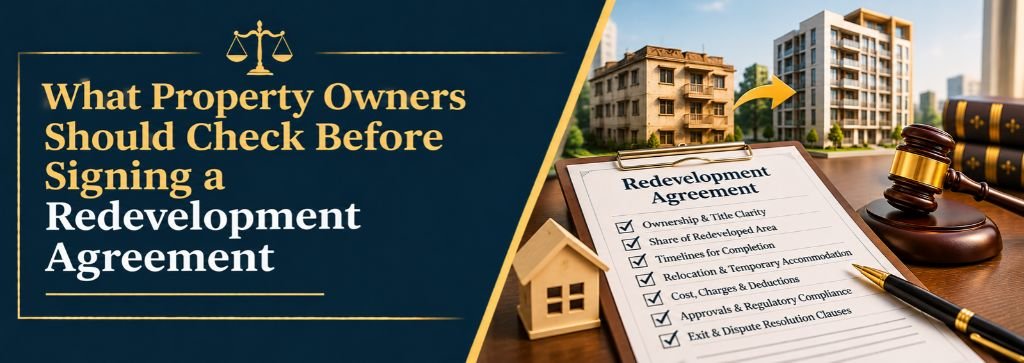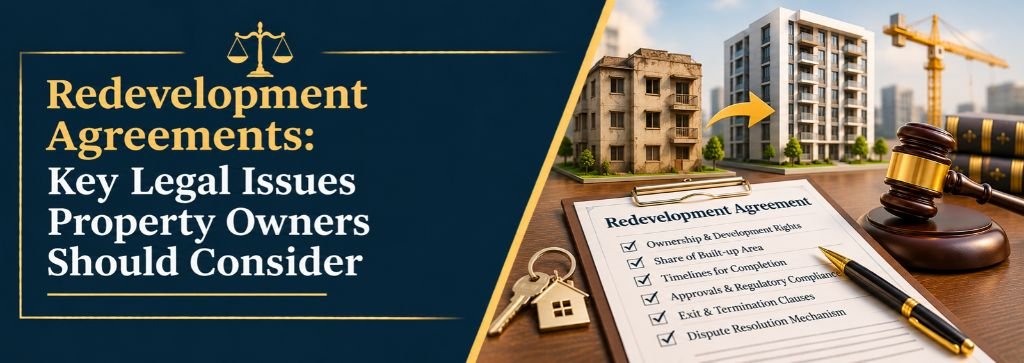
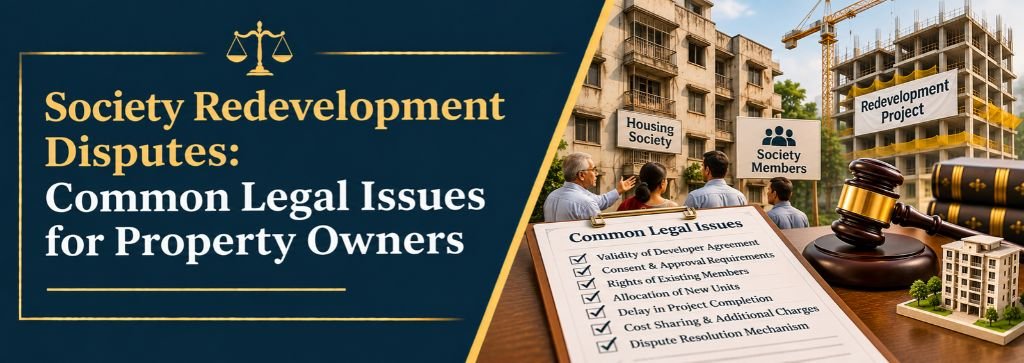
Redevelopment can give members of an ageing housing society safer homes, modern facilities and better use of valuable land. However, the process can also create disagreements over developer selection, member consent, additional carpet area, transit rent, construction delays and the distribution of benefits. Society redevelopment disputes often arise when members believe decisions have been taken without proper consultation or when the developer fails to fulfil commitments made before the building was vacated.
In India, redevelopment is governed by a combination of state cooperative society laws, government directions, property and contract law, local development regulations and, where applicable, the Real Estate (Regulation and Development) Act, 2016 (RERA). The legal position depends on the state, the society’s structure, ownership of the land and the documents executed. Understanding common disputes and the available remedies can help members protect their interests before disagreements escalate into litigation.
Why Do Housing Society Redevelopment Disputes Arise?
Redevelopment involves several parties, including society members, the managing committee, the appointed developer, architects, project consultants and government authorities. Each party may have different expectations about the project’s cost, feasibility, timeline and benefits. Disputes often begin when important decisions are made without adequate information or when the agreement does not clearly define the parties’ responsibilities.
Some disagreements concern the internal decision making process of the society. Others arise because of a developer’s financial difficulties, failure to pay transit rent, changes to approved plans or inability to complete construction. A dispute may affect one member or the entire society, depending on the nature of the issue.
Common Legal Issues in Society Redevelopment
1. Disputes Over Member Consent and Society Resolutions
One of the most common causes of redevelopment disputes is disagreement over whether the society has obtained the required member consent. Members may challenge a redevelopment resolution if proper notice was not given, relevant documents were not circulated, voting procedures were not followed or the managing committee acted beyond its authority.
The applicable consent requirements depend on the relevant state law, government directions, society bye laws and type of redevelopment. In Maharashtra, the Government Resolution dated 4 July 2019 sets out a procedure for redevelopment of cooperative housing societies. It addresses matters such as meetings, appointment of professionals and developer selection. These requirements should be read with subsequent applicable directions and the society’s governing documents.
A member’s disagreement with the majority decision does not automatically invalidate redevelopment. However, a decision made in breach of mandatory procedures may be open to challenge. Societies should preserve meeting notices, attendance records, minutes, voting details and resolutions to demonstrate a transparent decision making process.
2. Disputes Over Selection of the Developer
Members may disagree about the developer selected by the managing committee. Concerns can arise where the selection process lacks transparency, competing proposals were not fairly evaluated or the chosen developer has a history of delayed projects and financial difficulties.
A high offer of additional area or transit rent may influence members, but it does not necessarily indicate that the developer can complete the project. Before appointment, the society should examine the developer’s financial capacity, completed projects, ongoing commitments, litigation history and ability to secure approvals and construction finance.
If the appointment process violates applicable rules or the society’s own procedures, members may seek appropriate remedies before the competent authority or court. The society should maintain a record of proposals, comparative assessments, professional recommendations and the reasons for its final decision.
3. Disputes Over Additional Carpet Area and Member Entitlements
A redevelopment proposal may promise existing members additional carpet area, better layouts, parking or improved facilities. Disputes arise when members believe the final offer differs from the original proposal or when the agreement does not clearly define individual entitlements.
The development agreement and each member’s permanent alternate accommodation agreement should specify the carpet area, measurement method, flat allocation, specifications and other benefits. It should also address what happens if proposed development potential or approvals are reduced.
Members should compare the final documents with the approved society resolution and developer’s written offer. Verbal assurances about additional area or parking can be difficult to enforce if they are not properly recorded.
4. Non Payment of Transit Rent and Compensation
When members vacate their homes, the developer is generally required to provide the transit rent or temporary accommodation agreed in the redevelopment documents. Disputes arise when payments are delayed, reduced, stopped or not increased as promised. Members may also disagree over shifting expenses, brokerage, hardship compensation and the period for which rent remains payable.
The agreement should clearly specify payment dates, escalation, security and the consequences of default. Members should retain bank statements, receipts and written reminders. If several members face the same problem, the society may raise the issue collectively. Persistent non payment can amount to a serious contractual breach and may support a claim for recovery, damages or termination, depending on the agreement and circumstances.
5. Delay in Construction or Failure to Complete Redevelopment
A project may remain stalled because of financial difficulties, lack of approvals, disputes over possession, changes in development regulations or poor project management. Members may be left without their original homes while waiting for replacement flats. The longer the delay, the greater the financial and personal impact.
The development agreement should identify the construction commencement date, completion deadline, milestones and consequences of delay. It should also define permitted extensions and narrowly describe force majeure events. Where the developer repeatedly fails to perform, the society may consider contractual remedies, including termination, after following the required notice and cure procedure.
In A A Estates Private Limited v. Kher Nagar Sukhsadan Co-operative Housing Society Ltd. (2025 INSC 1366), the Supreme Court considered a prolonged redevelopment failure involving non payment of transit rent and failure to make meaningful progress. It upheld the society’s termination in the particular circumstances, where the contractual defaults and notices were established and termination preceded the developer’s insolvency proceedings. The decision is important, but it does not create an unrestricted right to terminate every redevelopment contract. The agreement, the parties’ conduct and any insolvency moratorium must be examined carefully. Read the Supreme Court decision in A A Estates v. Kher Nagar Sukhsadan.
6. Disputes Over Changes to Plans and Common Amenities
Members may object when the developer changes the proposed layout, reduces the promised carpet area, alters parking arrangements or removes facilities such as a clubhouse, garden or community hall. Such changes may affect the value and usability of replacement premises.
The society should compare the revised plans with the approved plans, development agreement and individual member documents. Where RERA applies, Section 14 regulates development in accordance with sanctioned plans and specifications and restricts certain alterations without the required consent. Planning authority approval and member consent are separate questions. Obtaining one does not necessarily remove the need to comply with the other.
7. Disputes Between Members and the Managing Committee
Internal disagreements may arise where members suspect favouritism, conflicts of interest, lack of transparency or unauthorised decisions by the managing committee. Some members may challenge the appointment of consultants or developers, while others may object to the distribution of additional benefits.
The committee should act within its powers, follow the society’s bye laws and maintain accurate records. Members should request relevant documents through the proper process and raise concerns in general body meetings. Allegations of misconduct should be supported by records rather than assumptions. Where a decision breaches cooperative law or the society’s governing documents, members may seek appropriate relief before the competent cooperative authority or court.
What Legal Remedies Are Available for Society Redevelopment Disputes?
The appropriate forum depends on the parties involved and the subject of the dispute. There is no single remedy for every redevelopment disagreement. A dispute between a society and its developer may be governed by the development agreement, including its arbitration clause. A dispute between a member and the society may fall within the jurisdiction of a cooperative forum under the relevant state law. A question of title or an issue involving public authorities may require proceedings before a civil court or constitutional court.
In Maharashtra, Section 91 of the Maharashtra Co-operative Societies Act, 1960 provides for specified disputes touching the constitution, management or business of a society to be referred to the Co-operative Court, where the statutory conditions are satisfied. It is important to assess whether the parties and subject matter fall within the section before filing. Read the Maharashtra Co-operative Societies Act, 1960.
Where the project is covered by RERA and the complaint concerns a breach of the Act, its rules or regulations, an aggrieved person may approach the relevant authority or adjudicating officer under Section 31, as appropriate. The section expressly includes an association of allottees within the meaning of a person for this purpose. However, RERA jurisdiction should not be assumed merely because a dispute relates to redevelopment. The project’s registration status, statutory exemptions and the complainant’s legal position must be checked. Read Section 31 of the RERA Act.
Depending on the facts, available relief may include directions to comply with contractual obligations, recovery of unpaid rent, compensation, interim protection, specific performance or termination of the agreement. Legal remedies for redevelopment disputes should be selected after identifying the correct forum, limitation period and relief sought. Starting proceedings in the wrong forum can cause delay and additional expense.
How Can Property Owners Prevent Redevelopment Disputes?
Prevention begins before the developer is appointed. The society should obtain an independent title search, appoint a qualified architect or project management consultant and evaluate competing developer proposals on financial and technical grounds. Members should receive clear information about the proposed additional area, transit rent, construction period, amenities and risks before voting.
The development agreement should record every important commitment. It should include payment schedules, performance security, construction milestones, approval responsibilities, defect liability, insurance and termination provisions. Individual permanent alternate accommodation agreements should be consistent with the main development agreement. Any promise made during negotiations should be incorporated into the signed documents.
Members should also monitor the project after signing. Regular progress reports, documented site inspections, payment records and written communication can help identify problems early. Understanding applicable Housing society redevelopment laws is essential because the rules governing consent, dispute resolution and redevelopment procedures differ between states and may also depend on whether the land belongs to a private society, MHADA or another public authority.
What Should Members Do When a Redevelopment Dispute Arises?
Members should first identify the exact issue and collect the documents relevant to it. These may include the society’s resolutions, meeting minutes, development agreement, individual member agreements, payment records, approved plans, correspondence and notices. A clear record helps establish whether the dispute concerns a procedural irregularity, contractual breach, statutory violation or ownership issue.
The society or affected members should then send a written representation identifying the breach and requesting corrective action within a reasonable period. If the issue remains unresolved, legal advice should be obtained before issuing a termination notice, withholding contractual payments or initiating proceedings. These steps can have consequences for the rights of both the society and the developer.
Where insolvency proceedings have commenced against the developer, the position requires particular care. The Insolvency and Bankruptcy Code may impose restrictions on proceedings and actions involving the corporate debtor. A society should not assume it can freely terminate an agreement or appoint a replacement developer during an insolvency process without examining the applicable moratorium and the status of its contractual rights.
Conclusion
Society redevelopment disputes can arise at every stage, from the appointment of a developer to the delivery of completed homes. Disagreements over consent, member entitlements, transit rent, construction delays and contractual defaults can affect the entire project and leave residents facing prolonged uncertainty.
Property owners should insist on transparent decision making, complete documentation and enforceable developer obligations. When a dispute occurs, identifying the correct legal forum and acting on documented evidence can help protect members’ interests. Early legal review and timely action are often more effective than waiting until the redevelopment project has stalled.
Frequently Asked Questions
1. Can a housing society cancel a redevelopment agreement?
Yes, a society may be able to terminate a redevelopment agreement where there is a valid contractual or legal ground, such as material breach or prolonged non performance. It must follow the agreement’s notice and termination procedure and consider any applicable statutory restrictions.
2. Can minority members stop society redevelopment?
Not automatically. A valid decision taken in accordance with applicable law and society procedures may bind members who disagree. However, members can challenge decisions involving procedural violations, lack of authority, fraud or breach of statutory requirements before the appropriate forum.
3. What happens if a developer stops paying transit rent?
Members should document missed payments and send written notices to the developer and society. Depending on the agreement, they may seek recovery, interest, compensation or other contractual relief. Persistent default may also support termination if the relevant legal requirements are met.
4. Can a managing committee appoint a developer without member approval?
The managing committee must act within the authority given by applicable cooperative law, government directions, society bye laws and valid general body resolutions. If mandatory approval or consent procedures are ignored, the appointment may be challenged.
5. Which court handles housing society redevelopment disputes?
The forum depends on the nature of the dispute and the parties involved. In Maharashtra, certain disputes between a society and its members may fall under Section 91 of the Maharashtra Co-operative Societies Act. Developer disputes may be subject to arbitration, while RERA or civil court proceedings may be appropriate in other circumstances.