
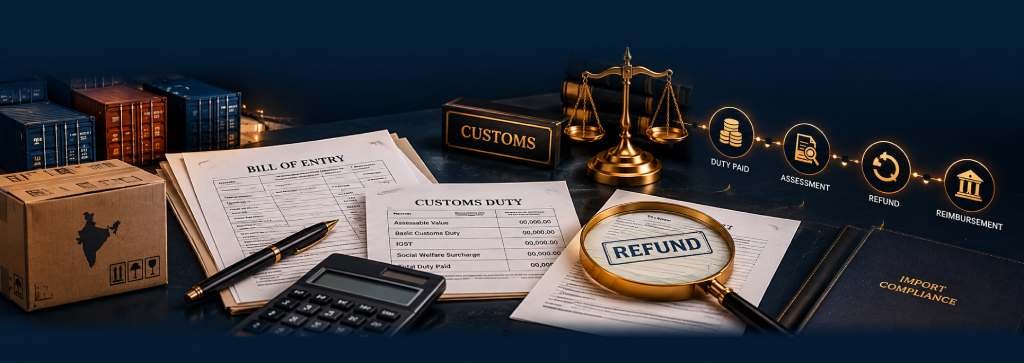
Importers may sometimes pay more customs duty than is ultimately payable due to reassessment, incorrect valuation, classification disputes or other circumstances. In such cases, a Customs Duty Refund can provide a mechanism for recovering eligible amounts from the customs authorities. However, a refund is not automatic merely because an importer believes excess duty was paid. The claim must satisfy the applicable provisions of the Customs Act, 1962, including requirements concerning limitation, supporting evidence and unjust enrichment. Understanding when a refund can be claimed and how the process works can help importers protect their financial interests.
Understanding Customs Duty Refund
Customs duty is generally levied on goods imported into India under the Customs Act, 1962 and the Customs Tariff Act, 1975. Section 12 of the Customs Act provides for levy of customs duties on goods imported into or exported from India, subject to the applicable law. A customs refund may arise when an importer has paid duty or interest in excess of the amount legally payable. Section 27 of the Customs Act specifically deals with claims for refund of duty and interest. It permits a person who has paid or borne the duty or interest to make an application to the Assistant Commissioner or Deputy Commissioner of Customs, subject to the statutory requirements. The reason behind the excess payment is important. A refund could arise following reassessment, correction of an assessment, a successful appeal, finalisation of provisional assessment or another legally recognised circumstance.
When Can Importers Claim a Customs Duty Refund?
One common situation occurs when an importer pays more duty than is ultimately payable. This can happen when the customs authorities reassess the goods at a lower value or accept a different tariff classification. Section 18 of the Customs Act deals with provisional assessment. When the final assessment is completed, the amount already paid is adjusted against the final duty liability. If the amount paid exceeds the duty finally assessed, the importer becomes entitled to a refund of the excess, subject to the applicable legal requirements.
A refund can also arise following an appellate or judicial decision. For example, an importer may have paid duty based on a particular classification and subsequently succeed in establishing a more favourable classification before the appellate authority or court. Section 27 specifically provides for situations where duty becomes refundable as a consequence of a judgment, decree, order or direction. Another situation involves excess duty payment before an order permitting clearance for home consumption is made. Section 27 expressly covers certain excess payments where the excess is evident from the self assessed Bill of Entry or reflected in a reassessed Bill of Entry.
Common Situations Leading to Refund Claims
Importers may encounter refund situations in several commercial circumstances. Incorrect classification is one example. Customs duty rates can differ considerably between tariff headings. If goods were initially classified under a heading carrying a higher rate and are subsequently reassessed under a heading carrying a lower rate, an excess payment may arise.
Valuation disputes can also lead to refunds. Where the final assessable value is lower than the value on which duty was initially paid, the resulting excess may be refundable subject to the statutory framework. Provisional assessments can create another route. An importer may initially pay duty based on a provisional assessment because certain information remains unresolved. Once the assessment is finalised, the importer may become entitled to a refund if the final liability is lower.
Refunds may also follow successful appeals. If an appellate authority or court determines that the importer was liable for a lower amount of duty, the resulting excess payment may become refundable. The exact route depends on the circumstances and the order or assessment giving rise to the refund.
What Is the Time Limit for Claiming a Refund?
The limitation period is one of the most important aspects of a customs refund claim. Section 27 generally requires an application for refund to be made before the expiry of one year from the date of payment of duty or interest. However, the section contains important exceptions and special rules. For example, the one year limitation does not apply where duty or interest has been paid under protest.
The Act also specifies how the limitation period operates in certain circumstances. Where the refund arises because of a judgment, decree, order or direction of an appellate authority, Tribunal or court, the one-year period is computed from the date of the relevant decision. In cases involving provisional assessment, the period is generally computed from the date of adjustment after final assessment or reassessment. Importers should therefore avoid assuming the limitation period always begins on the date when the original Bill of Entry was filed. The relevant date can depend on the circumstances giving rise to the refund.
What Is the Unjust Enrichment Principle?
One of the most significant issues in customs refund claims is unjust enrichment. Under Section 27, a refund is generally credited to the Consumer Welfare Fund unless the claim falls within circumstances where the amount can be paid directly to the applicant. The provision requires documentary or other evidence to establish both payment of the duty and the fact that its incidence was not passed on to another person. Section 28D creates a statutory presumption. It provides, subject to proof to the contrary, that a person who has paid duty is presumed to have passed the full incidence of the duty to the buyer.
This means an importer seeking direct payment of a refund may need to demonstrate that the customs duty was actually borne by the importer rather than recovered from customers through the sale price. Businesses should therefore preserve invoices, accounting records, costing documents and other evidence capable of showing how the duty was treated commercially.
What Documents Support a Refund Claim?
A strong refund application should be supported by documents establishing the basis of the claim. Depending on the circumstances, relevant records can include the Bill of Entry, duty payment evidence, assessment or reassessment orders, import invoices, customs correspondence and appellate orders. Where the claim concerns provisional assessment, documents showing finalization and adjustment can be important.
Evidence concerning unjust enrichment is also significant. Accounting records, sales invoices and other commercial documentation may help establish whether the duty burden was passed on to buyers. The exact documentation will vary according to the reason for the refund. An importer should therefore identify the legal basis of the claim before preparing its application rather than submitting a generic set of documents.
How Does the Customs Refund Process Work?
The importer generally needs to submit the refund application to the appropriate customs authority in the prescribed manner. Section 27 requires the claim to be made to the Assistant Commissioner or Deputy Commissioner of Customs. The customs authority then examines whether the claim satisfies the statutory requirements. This can include reviewing whether the claim is within the limitation period, whether excess duty was actually paid and whether the applicant has established the basis for the refund.
The authority also considers whether the amount should be paid directly to the claimant or credited to the Consumer Welfare Fund in accordance with the unjust enrichment provisions. A refund application should therefore be treated as a substantive legal and financial claim rather than merely an administrative request.
What Happens If Customs Rejects the Refund Claim?
A refund claim may be rejected wholly or partly if the importer fails to satisfy the statutory requirements. Possible issues include limitation, inadequate evidence, failure to establish excess payment or failure to overcome the presumption of unjust enrichment. The Customs Act provides an appellate framework for challenging eligible customs orders. Section 128 provides for appeals to the Commissioner (Appeals) against specified decisions or orders of customs officers. The appellate process can also apply to refund disputes.
The CBIC tax information portal records provisions concerning appeals against refund orders and recognises situations where a refund order may be challenged, including cases where an authority has credited an amount to the Consumer Welfare Fund without properly considering the evidence produced by the applicant. Importers should therefore examine the refund order carefully and consider the applicable limitation period before deciding whether to appeal.
How Professional Advice Can Help with Complex Refund Claims
Straightforward refund claims may be handled through the normal customs process. More complicated matters can involve classification disputes, reassessment, provisional assessment, appellate orders or questions concerning unjust enrichment. Businesses dealing with substantial amounts may benefit from advice on the legal basis of the refund, evidence requirements and procedural deadlines. A consumer lawyer may be relevant where the dispute also involves questions concerning consumer pricing or the treatment of duty in the sale of imported products. Tax and customs disputes can also involve detailed interpretation of statutory provisions. Businesses handling significant claims may therefore consider advice from tax law firms experienced in customs and indirect tax matters. Professional review can help identify evidentiary gaps before a claim is submitted.
How Businesses Can Improve Their Refund Claims
Importers should build refund readiness into their customs compliance systems. Accurate records of duty payments should be maintained from the time goods are imported. Businesses should also preserve assessment documents, reassessment orders and correspondence with customs authorities. Where duty is paid under protest, the importer should ensure the relevant records clearly establish the position. This can become particularly important where a future refund claim is expected.
Businesses should also monitor appellate proceedings and final assessment orders closely. A favourable order may trigger a refund opportunity, but the applicable limitation period should not be overlooked. Accounting teams should maintain clear records showing whether customs duty was included in the price charged to customers. This can become important when addressing unjust enrichment.
Difference Between Customs Refund and Duty Drawback
A customs refund should not be confused with duty drawback. A refund generally concerns recovery of duty or interest paid or borne by a person where the statutory requirements for refund are satisfied. Duty drawback is a separate statutory mechanism dealing with repayment of certain duties in specified export situations. The Customs Act contains specific provisions relating to drawback under Sections 74 and 75. Section 27 itself recognises drawback as one of the circumstances where an amount may be paid to the applicant rather than credited to the Consumer Welfare Fund. The appropriate mechanism therefore depends on the commercial transaction and the legal circumstances involved.
Why Timely Action Matters
A refund opportunity can be lost if the importer fails to act within the prescribed period. Section 27 contains a general one year limitation period, along with specific rules and exceptions. Businesses should therefore conduct periodic reviews of customs assessments and payments, particularly after successful appeals, reassessments or finalisation of provisional assessments. Early identification allows the importer to collect supporting records while they remain readily available. It also provides sufficient time to address questions concerning unjust enrichment and other procedural requirements.
Conclusion
Customs duty refunds can help importers recover amounts paid in excess of their actual legal liability. However, eligibility depends on the circumstances giving rise to the refund, compliance with statutory limitation periods and the ability to establish the claim through appropriate evidence.
Section 27 of the Customs Act provides the central framework for ordinary customs refund claims, while provisions concerning provisional assessment, reassessment and appeals can determine when a refund right arises. Importers must also consider the unjust enrichment principle, since the law generally requires evidence showing the duty burden was not passed on to another person before direct payment of the refund can be made.
For businesses engaged in regular imports, maintaining accurate customs records and monitoring assessments can make the refund process more efficient. A timely and well documented claim can protect working capital while reducing the risk of losing an otherwise valid refund due to procedural or evidentiary shortcomings.