
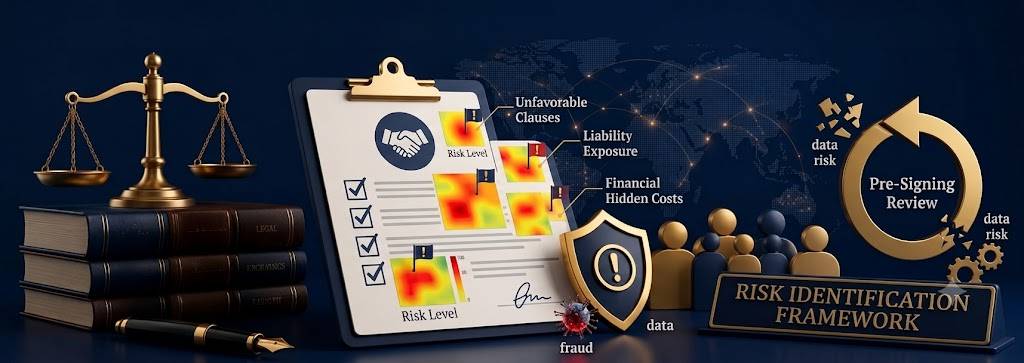
Every business enters into contracts to build commercial relationships, generate revenue, and support growth. However, every agreement also creates legal and commercial obligations. Identifying Contract Risks before signing an agreement is one of the most important steps a business can take to protect its financial interests and operational stability. Whether the agreement involves customers, suppliers, technology providers, investors, or strategic partners, careful contract review helps businesses avoid costly disputes, unexpected liabilities, and compliance challenges. Many contractual disputes do not arise because one party acts dishonestly. Instead, they result from unclear drafting, overlooked obligations, unrealistic commitments, or poorly allocated risks. Understanding Contract Risks before execution enables businesses to negotiate stronger agreements and establish more secure commercial relationships.
Understanding Contract Risks
Contract Risks refer to the legal, financial, operational, and commercial risks arising from the terms and conditions contained within an agreement. Every contract allocates responsibilities between parties. If these obligations are unclear or unbalanced, businesses may face unexpected consequences after signing. Contract risks vary depending on the nature of the transaction. A supplier agreement may create delivery risks, while a technology contract may involve cybersecurity and data protection concerns. Customer contracts often create performance obligations, whereas investment agreements may introduce governance and reporting requirements. Recognising these risks before signing allows businesses to negotiate suitable protections and reduce future uncertainty.
Why Contract Risk Assessment Is Important
Many organisations focus primarily on commercial opportunities when negotiating agreements. Revenue growth, new partnerships, and market expansion often receive greater attention than legal obligations. However, even a profitable agreement can become problematic if contractual risks are not properly evaluated. A thorough contract review helps businesses understand their obligations, identify hidden liabilities, evaluate financial commitments, and determine whether contractual expectations are realistic. Businesses adopting proactive contract risk assessment generally experience fewer disputes, stronger commercial relationships, and better operational outcomes. Effective risk identification supports long term business success.
Review Every Clause Carefully
One of the most common mistakes businesses make is reviewing only commercial terms while overlooking legal provisions. Every clause within a contract has potential legal consequences. Payment provisions, confidentiality obligations, intellectual property clauses, liability limitations, warranties, termination rights, compliance requirements, and dispute resolution mechanisms all deserve careful attention. Businesses should avoid assuming standard contract language is automatically acceptable. Even commonly used clauses may create significant obligations depending on the transaction. A detailed review helps identify provisions requiring clarification or renegotiation before execution.
Evaluate Performance Obligations
Every contract establishes expectations regarding performance. Businesses should assess whether contractual commitments can realistically be fulfilled using available resources, personnel, technology, and operational capacity. Unrealistic delivery schedules, strict service standards, excessive reporting requirements, or unrealistic quality obligations may expose businesses to unnecessary risks. Performance obligations should reflect practical business capabilities rather than overly optimistic assumptions. Careful evaluation reduces the likelihood of future breaches and strengthens commercial relationships.
Assess Financial Exposure
Financial obligations represent one of the most important areas of contract risk. Businesses should review pricing provisions, payment schedules, penalties, liquidated damages clauses, reimbursement obligations, minimum purchase commitments, and termination costs. Long term financial commitments should also be considered carefully. Some agreements appear commercially attractive but create significant financial burdens through hidden obligations or inflexible payment structures. Understanding total financial exposure helps businesses make informed commercial decisions. Financial risk assessment contributes directly to stronger budgeting and long term profitability.
Understand Liability Provisions
Liability clauses determine how financial responsibility is allocated if problems arise. Businesses should review limitation of liability provisions, indemnity clauses, warranties, insurance requirements, and compensation obligations carefully. Unbalanced liability provisions may expose one party to disproportionate financial risk. Businesses frequently seek advice from business contract lawyers in India to assess liability clauses and negotiate more balanced contractual protections. Effective liability management helps organisations protect financial stability while maintaining commercially practical agreements. Understanding liability allocation before signing reduces future legal uncertainty.
Examine Intellectual Property Clauses
Intellectual property often represents one of the most valuable business assets. Contracts involving software development, branding, consulting services, product design, research, technology licensing, or creative work should clearly address ownership rights. Businesses should confirm who owns newly created intellectual property, whether licences are exclusive or non exclusive, and what usage rights each party receives. Failure to clarify intellectual property ownership may result in costly disputes. Clear contractual provisions help protect innovation and preserve competitive advantages.
Review Confidentiality and Data Protection Obligations
Modern businesses frequently exchange confidential information during commercial relationships. Customer information, pricing strategies, business plans, financial records, technical information, and proprietary processes require appropriate protection. Contracts should contain well defined confidentiality obligations governing how sensitive information will be handled. Businesses should also review data protection provisions carefully, particularly when personal information is involved. Compliance with applicable privacy laws should be reflected within contractual arrangements. Strong confidentiality clauses reduce reputational and commercial risks.
Identify Regulatory Compliance Requirements
Commercial agreements often allocate responsibility for legal and regulatory compliance. Businesses should understand all contractual obligations relating to industry standards, consumer protection laws, employment regulations, environmental requirements, taxation, and data privacy. Failure to satisfy compliance obligations may result in contractual breaches as well as regulatory penalties. Contracts should clearly define which party is responsible for meeting specific legal requirements. Compliance related risk assessment helps businesses avoid unnecessary legal exposure.
Analyse Termination Rights
Many businesses concentrate on how contracts begin but pay insufficient attention to how they end. Termination provisions are among the most important contractual protections. Businesses should review termination rights, notice periods, post termination obligations, renewal provisions, and exit procedures carefully. An agreement lacking reasonable termination flexibility may restrict future business decisions. Understanding termination provisions allows organisations to manage changing commercial circumstances more effectively. Well drafted exit mechanisms reduce operational disruption if relationships end unexpectedly.
Consider Dispute Resolution Procedures
Even well managed commercial relationships may encounter disagreements. Contracts should establish practical mechanisms for resolving disputes. Businesses should examine dispute resolution clauses relating to negotiation, mediation, arbitration, jurisdiction, and governing law. The selected dispute resolution process should align with the commercial nature of the transaction. Efficient dispute resolution provisions help minimise legal costs while preserving valuable business relationships. Ignoring these clauses may result in unnecessary complexity during future disputes.
Assess Third Party Risks
Businesses should evaluate the reliability and capability of the other contracting party before signing an agreement. Due diligence may include reviewing financial stability, operational capacity, market reputation, regulatory history, litigation records, and industry experience. A well drafted contract provides legal protection, but it cannot eliminate every commercial risk associated with an unreliable business partner. Understanding third party risks supports more informed contractual decision making. Careful due diligence complements strong legal drafting.
Technology Related Contract Risks
Digital transformation has increased the importance of technology contracts. Cloud service agreements, software licences, cybersecurity arrangements, artificial intelligence solutions, and technology outsourcing contracts often contain complex legal provisions. Businesses should review service levels, data ownership, security obligations, intellectual property rights, liability provisions, and system availability commitments carefully. Technology related contractual risks may affect business continuity significantly. Proper review helps organisations reduce operational disruption and maintain regulatory compliance.
Develop an Internal Contract Review Process
Businesses managing multiple agreements benefit from structured contract review procedures. Internal review processes improve consistency and reduce the likelihood of overlooked risks. Contracts should be reviewed by relevant commercial, operational, financial, and legal personnel before execution. Cross functional collaboration often identifies issues individual reviewers may overlook. Documenting review procedures also strengthens governance and improves organisational accountability. Effective contract management begins before agreements are signed.
The Value of Professional Legal Advice
Complex agreements frequently contain sophisticated legal provisions requiring specialised interpretation. Professional legal review helps businesses understand obligations, identify hidden risks, strengthen protections, and negotiate improved terms. Many organisations consult the best corporate law firms in India when negotiating significant commercial agreements involving substantial operational or financial commitments. Legal guidance often prevents disputes and protects business interests more effectively than attempting to resolve problems after contracts have been executed. Professional review represents a valuable investment in long term commercial success.
The Importance of Ongoing Contract Monitoring
Risk management should continue after contracts are signed. Businesses should monitor contractual obligations regularly to ensure compliance with performance commitments, reporting requirements, payment schedules, renewal dates, and regulatory obligations. Periodic contract reviews help identify changing business circumstances requiring amendments or renegotiation. Strong contract management supports operational efficiency and reduces future legal exposure. Businesses treating contracts as active management tools rather than static documents generally experience stronger commercial outcomes.
Conclusion
Every commercial agreement creates opportunities alongside responsibilities. Identifying Contract Risks before signing enables businesses to understand obligations, negotiate stronger protections, and avoid costly disputes. From liability provisions and financial commitments to intellectual property ownership, confidentiality obligations, regulatory compliance, and dispute resolution procedures, every contractual element deserves careful review. Businesses investing time in comprehensive contract assessment create stronger commercial relationships, reduce legal uncertainty, and improve long term operational stability. Contract risk management is not simply a legal exercise. It is an essential business strategy supporting sustainable growth, informed decision making, and commercial resilience.